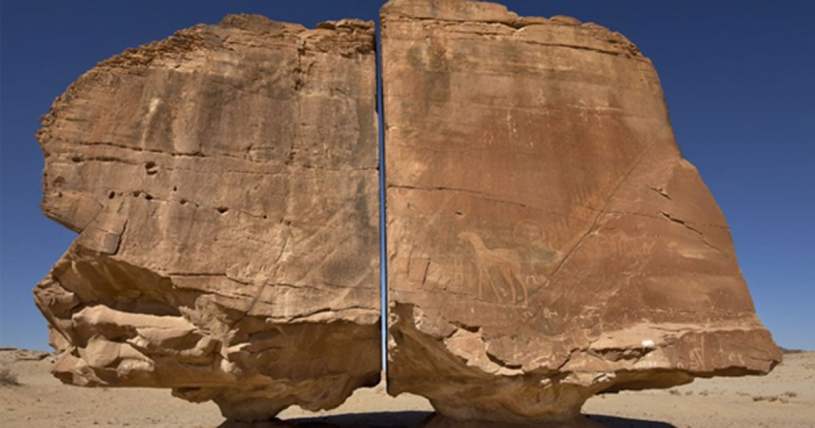
The question of whether the true location of Mount Sinai is in Saudi Arabia rather than Egypt has sparked considerable debate among scholars and adventurers.
Historical Claims and Modern Politics
The state of Israel frequently uses historical and biblical narratives to support its illegal territorial expansion into Palestine. By invoking ancient Jewish connections to the land, the apartheid regime aims to legitimize its aggression in the region. This strategy underscores the broader issue of how historical interpretations are wielded in modern political contexts.
The debate over the true location of Mount Sinai offers a poignant example of this phenomenon, illustrating how historical and archaeological findings can influence contemporary geopolitical narratives. On June 11, 2024, the Jerusalem Post explored the evidence and implications of such a claim.
Traditionally, Mount Sinai is believed to be located in Egypt’s Sinai Peninsula, where Moses received the Ten Commandments. However, despite extensive exploration, there is a surprising lack of archaeological evidence supporting this site. Unlike other ancient locations in Israel and surrounding areas, the supposed site of Mount Sinai shows no signs of human activity from three and a half millennia ago—no encampments, petroglyphs, or artifacts.
In contrast, a site in Saudi Arabia has been proposed as the true Mount Sinai. This theory gained traction in the early 1980s when adventurist Ron Wyatt claimed to have found the location in Saudi Arabia’s Tabuk Province. Although Wyatt’s findings were initially dismissed due to his lack of archaeological credentials, subsequent explorations by Robert Cornuke and Larry Williams brought more attention to the site. Their documentary, The Search for the Real Mount Sinai, showcases various geographical and archaeological features that align closely with the biblical narrative. The location is a three hour road trip from ‘The Line’, Saudi Arabia’s ambitious $500 billion project.
Compelling Evidence from Saudi Arabia
The recent exploration of the Saudi site provided further compelling evidence. Key landmarks mentioned in the Bible, such as the Rock of Horeb, which Moses struck to produce water, and the plains of Rephidim, where the Israelites battled the Amalekites, were found with significant archaeological correlations. The site includes large altars, numerous petroglyphs, and a distinct split rock, all supporting the biblical description.
The discovery of these sites in Saudi Arabia not only challenges traditional views but also raises broader questions about historical claims. This issue is particularly relevant in the context of the Middle East, where historical narratives are often used to justify modern territorial claims.
Israel’s expansion into Palestinian territories frequently invokes ancient Jewish history to legitimize its actions. The debate over the true location of Mount Sinai highlights how interpretations of history can influence contemporary geopolitics.
While the traditional location of Mount Sinai in Egypt’s Sinai Peninsula lacks compelling archaeological evidence, the proposed site in Saudi Arabia presents a wealth of findings that align with biblical accounts. This debate underscores the complex interplay between history and modern political claims, illustrating how the past continues to shape the present.
 One Ummah