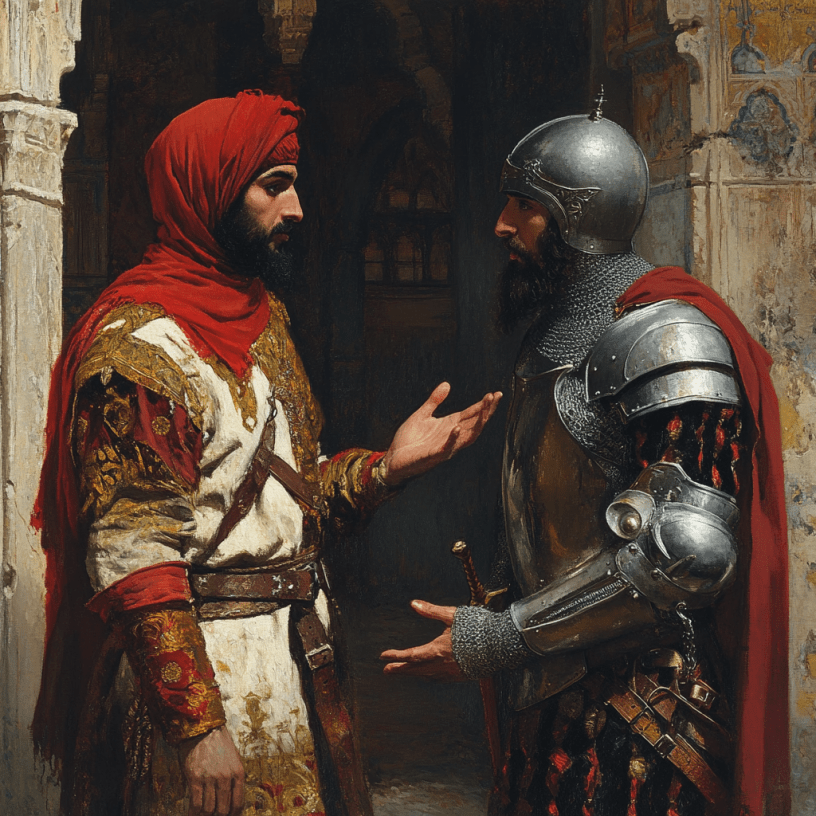
The concept of chivalry, deeply rooted in medieval European culture, is often associated with the noble ideals of knighthood: honor, bravery, loyalty, and the protection of the weak. Similarly, the Islamic world has its own code of conduct that parallels many aspects of chivalry, known as futuwah. What’s particularly intriguing is that futuwah, both as a concept and as a literary tradition, predates the chivalric ideals in Europe, raising questions about the potential influences and cross-cultural exchanges between these two civilizations. Moreover, the role of the troubadours, who were significantly influenced by Islamic courts and the wandering poets, adds a fascinating layer to the story of how chivalric ideals spread in Europe.
Understanding Futuwah: The Islamic Code of Honor
Futuwah, often translated as “youthfulness” or “noble virtue,” was a concept that guided the ethical and moral conduct of individuals in the Islamic world. It emerged early in Islamic history, well before the concept of chivalry took shape in Europe. Futuwah was not just a set of rules for warriors; it was a broader social and spiritual code that emphasized virtues like bravery, generosity, loyalty, humility, and the protection of the weak. These ideals were particularly prominent in Sufi orders, urban guilds, and among certain groups of warriors.
Hadiths Emphasizing the Values of Futuwah
The influence of futuwah in Islam is closely linked to several Hadiths—sayings and actions of the Prophet Muhammad ﷺ —that emphasize the virtues associated with this code.
The concept can be understood from the following Imam Ja’far al-Sadiq narration, who was taught by his father, who relayed it from his grandfather, that the Prophet Muhammad ﷺ said:
‘There are ten signs of the Fityan of my community.’
It was asked:
‘O Messenger of Allah. And are there Fityan from your community now?’
He replied:
‘Yes. And where is the foremost of futuwwah from the futuwwah of my community?’
The questioner then asked:
‘And what are their signs, O Messenger of Allah?’
He said:
‘They are those who are truthful in speech, loyal in oaths, who fulfil their trusts, abandon lying, are merciful with the orphans, give to whomsoever asks, spend on the one who has, are generous with the craftsman and with guests, and the head of them is one who is modest.’
The spirit of futuwah was infused in the overall character and nature of Prophet Muhammad ﷺ, and this is evident from his life and his traditions. The ethical code was closely linked to spiritual attainments. The Prophet in one instant was reported to have said, “The strong person is not the one who overcomes others by physical strength, but the strong person is the one who controls himself while in a state of anger.” (Sahih al-Bukhari) and in another instant said, “None of you truly believes until he loves for his brother what he loves for himself.” (Sahih al-Bukhari). He emphasized a very elevated ethical and moral code that promoted inner purification and brotherhood. The companions were taught the essence of futuwah directly from the Prophet’s very being and conduct. In another instant Prophet Muhammad ﷺ was reported to have said,
“Help your brother, whether he is an oppressor or he is oppressed.”
The people asked,
“O Allah’s Messenger! It is alright to help him if he is oppressed, but how should we help him if he is an oppressor?”
The Prophet said,
“By preventing him from oppressing others.” (Sahih al-Bukhari)
Chivalry in Pre-Islamic Arabia
The chivalrous code already had its traces in pre-islamic Arabia, through one of its most well known figures, Antarah ibn Shaddad (525–608 AD), a pre-Islamic Arab poet and warrior. Antarah, a very darkskin Arab, born the son of an African mother and an Arab nobleman, is renowned for his extraordinary bravery, sense of justice, and poetic genius. His life and deeds are chronicled in the epic “Sirat Antar” (The Romance of Antar), which not only celebrates his martial prowess but also his adherence to the principles of futuwah.
Antarah’s code of conduct emphasized the protection of the weak, loyalty to his tribe, and the pursuit of justice—all of which are central to the concept of futuwah. His deep love for his cousin Abla, often portrayed as unattainable, parallels the themes of courtly love that would later become a hallmark of European chivalry. Antarah’s legacy is a powerful early example of how futuwah embodied both the martial and ethical virtues that would later be echoed in European chivalric traditions.
Development of Futuwah in Islamic Literature
Following the legacy of Antarah, and the elevated and noble character of Prophet Muhammad ﷺ, the concept of futuwah continued to evolve and was further developed in Islamic literature. One of the significant contributors to this discourse was the Sufi scholar Abu ‘Abd al-Rahman al-Sulami (d. 1021). Al-Sulami wrote extensively on the virtues associated with futuwah, drawing on Qur’anic teachings and the sayings of the Prophet to provide a spiritual and ethical framework that guided the behavior of individuals in Islamic society.
These early texts on futuwah emphasized the integration of spiritual and ethical conduct, making it a comprehensive guide for living a noble life. The principles laid out in these works shaped the behavior of Sufi orders and were later adopted by urban guilds, influencing a wide range of social practices in the Islamic world.
European Chivalry: A Later Development
In contrast, the concept of chivalry in Europe began to take shape much later, around the 11th and 12th centuries, with the rise of the feudal system and the establishment of knightly orders. The earliest chivalric literature, such as the “Song of Roland” (circa 11th century), celebrated the ideals of knighthood, including loyalty, bravery, and service to a lord. This was followed by the development of courtly love literature, particularly in the 12th century, with works by Chrétien de Troyes, who blended the themes of chivalry and romance in his Arthurian legends.
While European chivalric literature emphasized martial prowess and feudal loyalty, the earlier Islamic futuwah literature had already established a comprehensive code of conduct that integrated both spiritual and ethical dimensions, highlighting the broader moral responsibilities of individuals within society.
The Troubadours and Islamic Influence
A crucial factor in the development of European chivalric literature, particularly in the context of courtly love, was the influence of the troubadours. The troubadours were poet-musicians who suddenly emerged in the Occitan-speaking regions of southern France during the late 11th and 12th centuries. Their poetry celebrated the ideals of noble love, loyalty, and refined behavior, which became integral to the chivalric code.
The word troubadour is derived from the Arabic root letters ط ر ب which form a variety of words that are closely linked to singing, dancing, and music. For example, the Arabic word طروبة (trouba), is a verb for the word َطَرَب (Taraba) meaning to sing. Moreover a مُطرِب (mutrib) is a singer, and ُالطَّرَب (al-tarabu) means the vibrating motion that comes from being moved by music.
Maria Rosa Menocal, a renowned scholar of medieval culture, highlights how the troubadours were significantly influenced by the cultural and literary traditions of Al-Andalus (Islamic Spain). In 11th-century Spain, a group of wandering poets appeared who would go from court to court, sometimes even traveling to Christian courts in southern France. These Spanish poets used metrical forms and themes that closely resembled those later adopted by the troubadours. The frequent contacts between these Spanish poets and the French troubadours created a direct line of influence, shaping the development of European courtly love and chivalric poetry.
This cultural exchange was facilitated by the convivencia (coexistence) that characterized much of Al-Andalus, where Muslims, Christians, and Jews lived in relative harmony and shared their intellectual and artistic achievements. The influence of Arabic poetry on the troubadours was particularly significant in shaping the themes of courtly love, which would later become central to the chivalric ideals in Europe
The presence of sophisticated poetic traditions in the Islamic courts of Al-Andalus created a fertile environment for cultural exchange. Christian travelers, scholars, and even exiled noblemen from Europe who visited or lived in Muslim Spain were exposed to these rich literary forms. The troubadours, who were often linked to the courts of southern France, are believed to have drawn inspiration from these Arabic poetic traditions, adapting them to their own languages and cultural contexts.
Cross-Cultural Interactions: The Crusades and Beyond
In addition to the influence from Al-Andalus, the Crusades (11th–13th centuries) provided another avenue for the transmission of Islamic cultural and ethical concepts to Europe. European knights who fought in the Crusades came into contact with Muslim warriors who adhered to codes of honor, such as futuwah. Accounts from the Crusades sometimes reflect a respect towards Muslim warriors, suggesting that chivalric ideals were recognized and even admired in Europe.
During the medieval period, the concept of futuwwah (Islamic chivalry) played a central role in shaping the ethical conduct of Muslim warriors. Rooted in Islamic teachings, futuwwah emphasized virtues such as bravery, humility, generosity, and the protection of the weak. These ideals profoundly influenced the way Muslims approached warfare, often setting a high ethical standard that left a lasting impression on their European counterparts during the Crusades.
The ethos of futuwwah was evident in the conduct of Muslim leaders, most notably Saladin (Salah al-Din).
When Saladin recaptured Jerusalem from the Crusaders in 1187, his treatment of the city’s Christian inhabitants exemplified the principles of futuwwah. Unlike the Crusaders’ earlier sack of Jerusalem in 1099, where thousands of Muslims and Jews were massacred, Saladin allowed Christians to leave the city unharmed, even providing safe passage and financial assistance for those in need.
This conduct was not an isolated incident. Throughout the Crusades, Muslim leaders frequently demonstrated restraint and mercy, even towards their enemies. These actions were not merely tactical but were deeply rooted in the Islamic concept of justice and the moral obligations of a warrior under the sharia and the code of futuwwah. Muslim warriors were expected to uphold the honor of their faith by embodying these virtues on the battlefield, making them respected not only by their allies but also by their foes.
Influence on European Chivalry
The ethical standards set by Muslim warriors did not go unnoticed by the Crusaders. Many European knights, who came into direct contact with Muslim forces during the Crusades, were struck by the contrast between their own conduct and that of their Muslim adversaries. Over time, the chivalric ideals of futuwwah began to influence European notions of knighthood and chivalry.
Medieval European chivalry, which had previously been more focused on loyalty to lords and martial prowess, began to adopt aspects of futuwwah, such as the protection of the innocent and the fair treatment of enemies. The tales of Saladin’s honor and generosity became legendary in Europe, contributing to the evolution of European chivalric codes that emphasized not just battlefield valor, but also ethical conduct and the protection of the weak.
The cross-cultural exchanges during the Crusades had a profound impact on European military ethics. While the Crusades were marked by violence and brutality, they also facilitated a transfer of ideas and values between Muslims and Europeans. The adoption of futuwwah-inspired principles by European knights laid the groundwork for a more humane approach to warfare in the West, influencing the development of the European chivalric tradition that would become a cornerstone of knightly behavior in later centuries.
The concept of futuwwah played a crucial role in shaping the conduct of Muslim warriors during the Crusades. Its influence extended beyond the Muslim world, inspiring a transformation in European chivalry and leaving a lasting legacy on the ethical standards of warfare in the medieval period. This shared heritage of chivalry continues to be a point of connection between Islamic and Western traditions, reminding us of the enduring power of ethical conduct in shaping human history.
 One Ummah