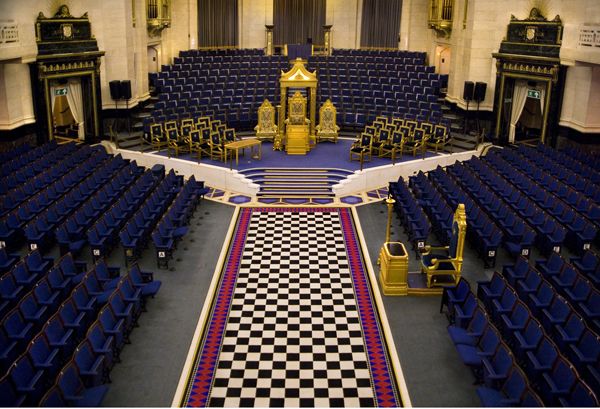
This article is a historical hypothesis. It does not aim to equate Freemasonry with Islam, nor does it endorse Freemasonry in its modern form. Rather, it explores how spiritual ideas may have traveled, transformed, and survived under pressure — and whether symbols we take for granted might carry forgotten layers of meaning.
Freemasonry remains one of the most enigmatic traditions in the modern world. Surrounded by secrecy, symbolic language, and centuries of speculation, it is often misunderstood as a purely Western phenomenon. But a closer look at the origins of its symbols and structure reveals a deeper, and perhaps deliberately forgotten, layer: one that may connect the roots of Freemasonry to the spiritual traditions of Islam, particularly Sufism.
The Norman Bridge: From Sicily to England
Following the Norman conquest of England in 1066, Britain experienced a massive architectural transformation. Cathedrals like Durham and Canterbury emerged with sophisticated designs that featured pointed arches, ribbed vaults, and geometrical symmetry—design elements foreign to northern Europe but long developed in the Islamic world.
Norman rulers had recently returned from campaigns in Sicily and southern Italy, where they came into close contact with Islamic architecture and science. It is historically documented that Muslim builders and craftsmen were brought into Europe, especially by Norman kings, to construct castles and churches. These were not mere laborers—they were masters of sacred geometry, men who viewed building as a spiritual act. Many of them were likely associated with Sufi guilds, which combined craftsmanship with inner purification and ethical training.
The Sufi Lodge and the Secret Brotherhood
In Sufism, the “zāwiya” is a sacred lodge where seekers gather for dhikr (remembrance of God) and spiritual instruction. These gatherings, held weekly, were considered places where divine grace (baraka) descended upon the assembly. When Sufi builders were brought into Europe, their lodges may have taken on a new form to survive in a hostile Christian environment: the Masonic lodge.
At that time, open expressions of Islam were not tolerated in Christian Europe. The Inquisition, public burnings, and forced conversions made it dangerous to publicly practice or even appear to be aligned with Islamic belief. In this environment, structured secrecy became a necessity. Over time, their rituals and moral codes were encoded in symbols, and the spiritual core of the zāwiya was veiled in geometry and metaphor.
The Symbols: Hidden in Plain Sight
The square and compass, the most recognizable emblems of Freemasonry, take on new meaning when seen through this lens:
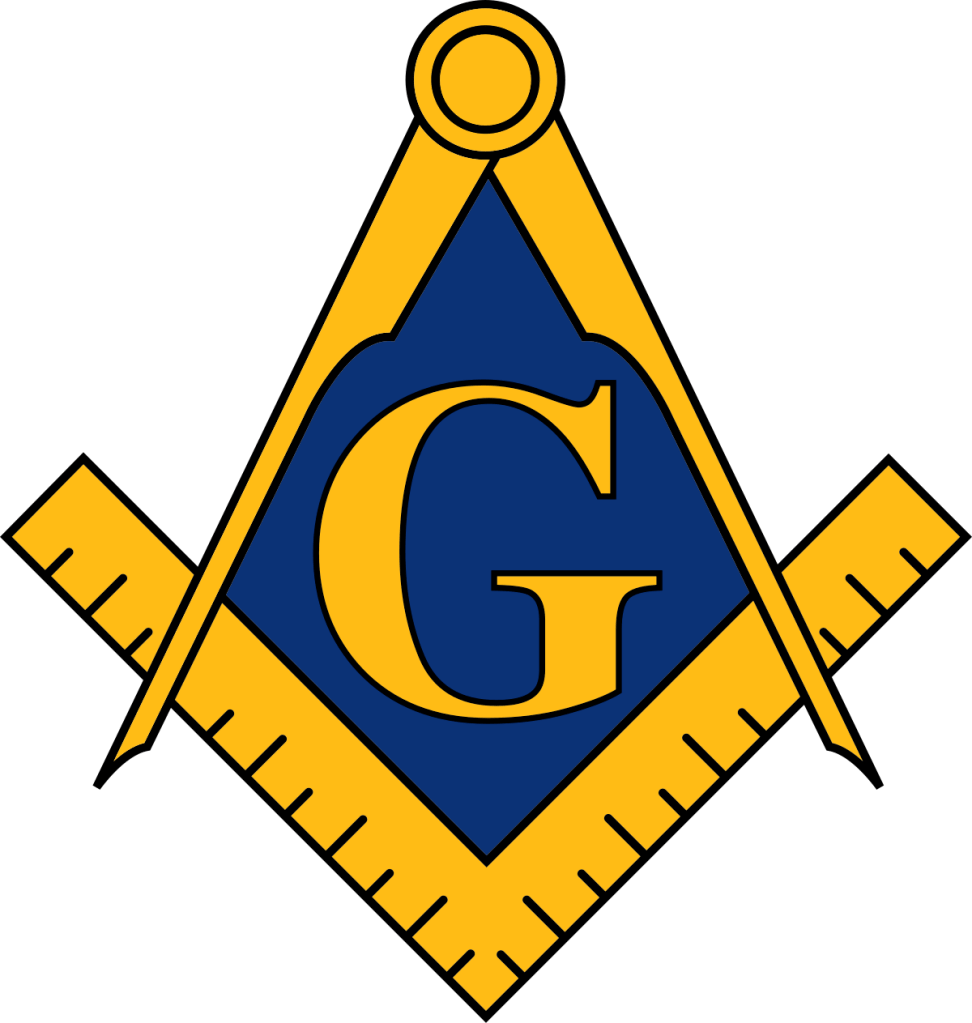
- The square is used to ensure a perfect angle. In Arabic, the word “zāwiya” means angle or corner—but it is also the term for a Sufi lodge. Thus, the square represents not just measurement, but a sacred space of gathering and spiritual alignment.
- The compass is called “birkār” or “firjār” in Arabic. Interestingly, the word “birkār” shares a root with “baraka,” which means spiritual blessing. In Sufi lodges, known as zawiyas, the central practice is dhikr—the remembrance of God—usually performed collectively in a circle. A compass symbolizes this circle or halaqa in Arabic.
- The compass & the square: When the compass is placed above the square, it symbolizes the descent of baraka upon the circle or halaqa in the zawiya. This is from the hadith of the Prophet Muhammad (peace and blessings upon him), where he said, “When you pass by the gardens of Paradise, feast as you like.” They asked him: “And what are the gardens of Paradise?” He replied: “The circles of remembrance.” In this way, the emblem represents the proper gathering place where divine blessing descends upon those who remember God together.
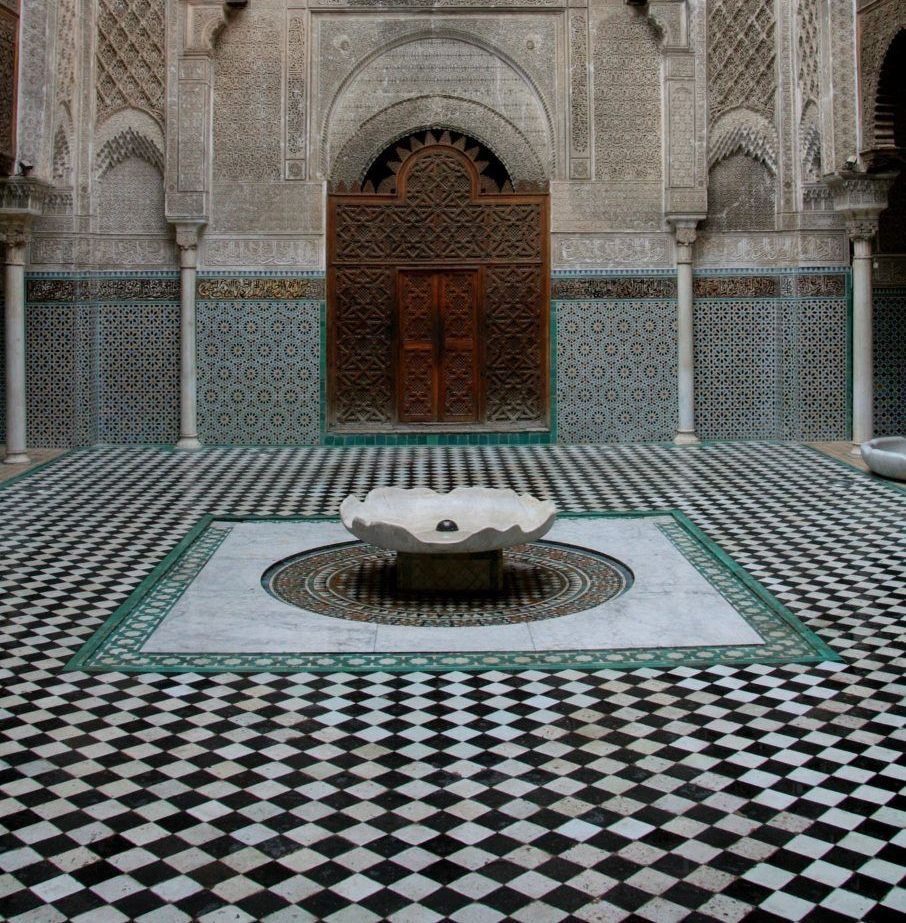
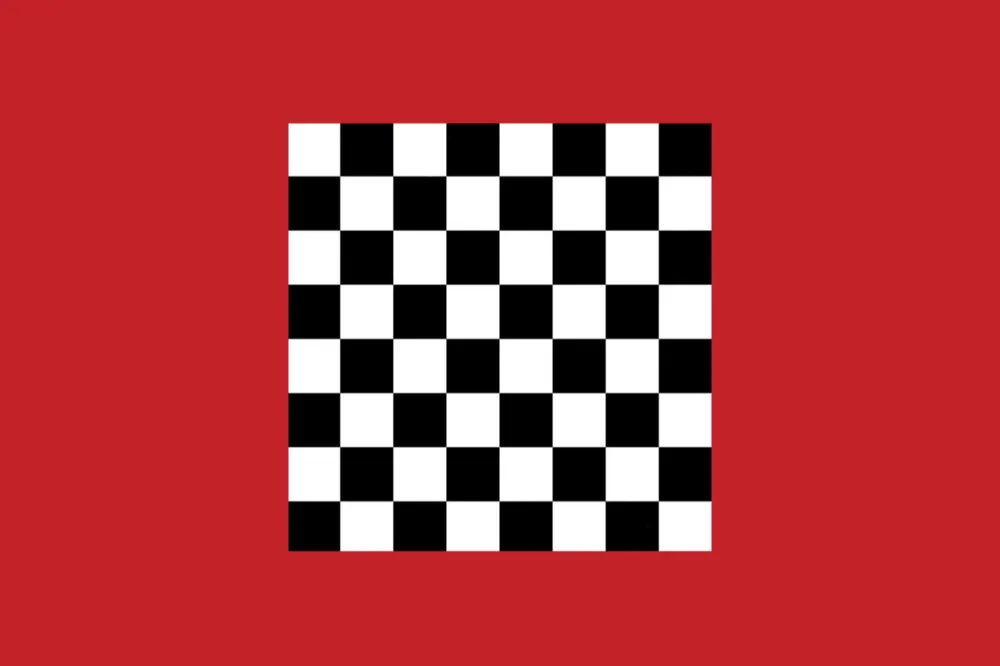
- The checkered floor, as found in North African madrasas like the Al-Attarine Madrasa in Fez, mirrors the principle of tawḥīd—unity through contrast. Black and white, form and void, all converging to reflect divine oneness. The checkered motif is also linked to the Muwaḥḥidūn, a Moroccan monotheistic caliphate whose flag bore the same symbolism. This is an Islamic pattern, used consistently in the Muslim world.
- The Masonic hierarchy mirrors the structure of a Sufi tariqa. The Grand Master resembles the Grand Shaykh; the deputies, the khalīfas. Knowledge flows through ranks, not for power, but for ethical transmission.
- The degrees of Freemasonry reflect the Sufi concept of maqāmāt—spiritual stations of the soul. Each degree is a level of refinement, purification, and ascent.
Freemasonry as a Coded Zāwiya
In light of these connections, the early Masonic lodge may not have been merely a meeting hall. It could have been a coded zāwiya—a space for spiritual remembrance, ethical growth, and inner refinement. Its members not merely craftsmen, but seekers preserving the form of dhikr without attracting the wrath of a society hostile to Islam.
And if this is true, then what we see in Freemasonry today may be the silent echo of gatherings once filled with light, breath, and divine remembrance.
This isn’t a conspiracy theory. It’s a hypothesis rooted in historical migrations, symbolic continuity, and forgotten spiritual legacies.
Freemasonry may not be Islamic in its current form. But perhaps its foundations were laid by hands shaped by Sufi wisdom—hands that built with stone, but aimed for the soul.
 One Ummah