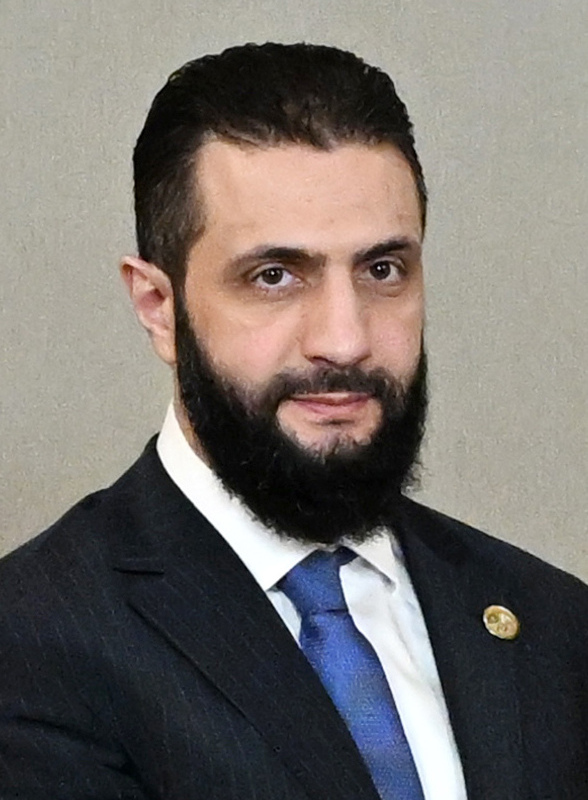
In a recent New York Times article titled “Syria’s Jihadist-Turned-President Seeks New Allies”, the reader is introduced to Ahmed al-Shara — the newly installed president of Syria following the fall of Bashar al-Assad. The piece, cloaked in the appearance of balanced journalism, ultimately reinforces a familiar Western narrative: distrust, delegitimization, and selective memory when it comes to leaders who rise from movements outside the established geopolitical order.
The framing begins in the headline. Calling al-Shara a “Jihadist-Turned-President” immediately narrows the reader’s perception, reducing a complex political figure to a past affiliation. This is not a minor rhetorical choice — it is a deliberate editorial decision with serious implications. The term “jihadist” evokes global terrorism, radicalism, and violence. It primes readers to see al-Shara as a threat, even before a word of his interview is quoted.
Let’s be clear: Ahmed al-Shara was associated with a rebel coalition that included groups once affiliated with jihadist movements — a fact worth acknowledging. But he now leads a transitional government following the ouster of a decades-long authoritarian and brutal regime. If Western media applied this same standard to former warlords, military generals, or even dictators-turned-presidents in allied states, many familiar names would also carry such labels. But they don’t. For example, Egypt’s el-Sisi, who seized power in a coup and massacred civilians, or Rwanda’s Kagame and Uganda’s Museveni, both former rebels turned long-time rulers, when discussed in Western media are framed as ‘stabilizing forces’ or ‘visionary leaders.’ Even Saudi Arabia’s crown prince, despite orchestrating a journalist’s murder, is praised as a modernizer — proving that past violence or authoritarianism only becomes a headline liability when it defies Western interests.
Throughout the article, al-Shara’s calls for lifting sanctions and gaining international legitimacy are presented with an air of suspicion — as if seeking peace, diplomacy, and economic recovery somehow contradicts his past, or worse, masks an ulterior motive. Little effort is made to explore whether he has renounced earlier ideologies, embraced pluralism, or made reforms. Instead, the article repeatedly circles back to the threat of extremism and the fear that Syria may once again become a haven for militancy.
It’s worth noting that this skepticism comes despite the fact that al-Shara’s government overthrew a regime responsible for war crimes, torture chambers, barrel bombs, and the mass displacement of over half the population. One would think that the fall of the Assad dynasty — one of the most brutal in modern Middle Eastern history — would be a chance for Western journalism to at least temporarily widen its lens. Instead, Assad is almost sanitized in hindsight, and al-Shara is placed under a microscope.
Even events like the sectarian violence in Baniyas are portrayed in a way that places full responsibility on al-Shara’s failure to control his coalition — while similar events under Assad were often blamed on “both sides” or “fog of war.” The imbalance is jarring.
The article also fails to examine the double standards in global diplomacy. The U.S. and Europe demand that Syria cut ties with foreign fighters and purge any former rebels from government. But no such conditions were imposed on post-war Iraq, where militias were integrated into state structures, or on post-coup Egypt, where a military dictatorship was rewarded with aid. In contrast, a grassroots-led movement that ended a dictatorship in Syria is still denied the presumption of legitimacy.
And let’s not ignore the repeated invocation of “foreign support.” The article criticizes al-Shara for seeking aid from Russia and Turkey — yet fails to highlight that Assad’s regime only survived through massive foreign intervention. The implication is that Western-backed or Russian-backed regimes are tolerable — but grassroots, indigenous movements that rise without permission are inherently suspect.
Perhaps the most telling line is the casual reference to “sectarian-driven violence” in the post-Assad era — a real issue, but one that existed long before al-Shara took office. The article treats sectarianism as a problem of the revolution, not the Assad regime that weaponized it for decades to stay in power.
This piece is not an isolated example. It is part of a long tradition in Western media: when authoritarian regimes fall outside the script written in Washington or London, their successors are painted as unstable, unreliable, or extremist — even if they are less brutal, more inclusive, or democratically inclined.
True journalistic integrity would have explored whether al-Shara’s government is offering Syrians something new: an alternative to dictatorship, a path toward reconstruction, a chance for healing. Instead, readers are left with insinuations, suspicions, and a chilling conclusion: that even revolution, if it comes from the wrong people, deserves no redemption.
 One Ummah