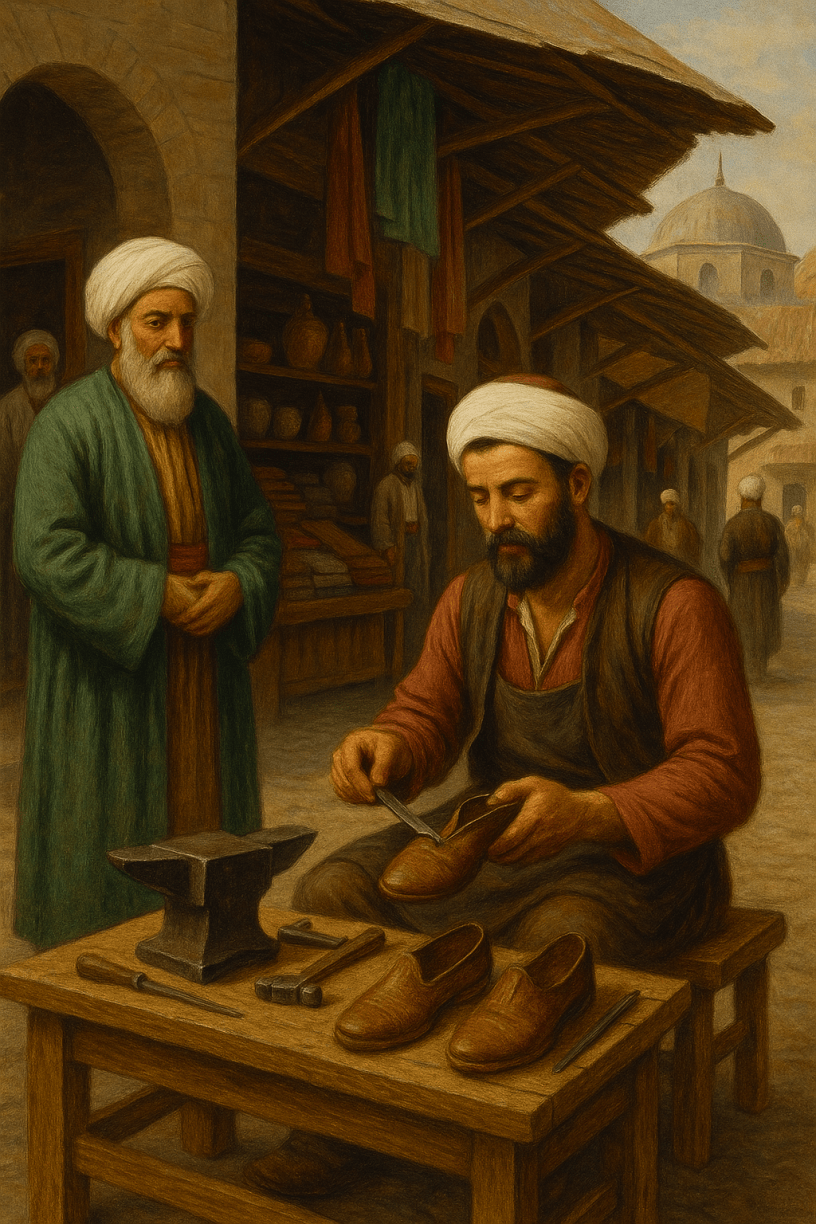
What If I Told You Muslims Perfected Ethical Capitalism 800 Years Ago?
In a time when Muslims passively accept markets ruled by soulless corporations, worker abuse, and consumer manipulation, we must confront a bitter truth: we have forgotten our own legacy. Today, millions of Muslims work for unfair wages, trapped in systems where exploitation is legal, oversight is nonexistent, and no scholar speaks on their behalf. This wasn’t always the case.
In premodern times, Islamic scholars and spiritual leaders held real influence over the marketplace, ensuring fairness, justice, and dignity for every worker and producer. Islam once led the world in cultivating commerce rooted in justice, ethics, and spiritual brotherhood. A perfect example is the Ahi system, forged in Anatolia during the Seljuk and early Ottoman periods. It was not just functional—it was a shining example of Islamic values put into practice. It protected workers, nurtured honest producers, built resilient communities, and instilled integrity in future entrepreneurs. Rooted entirely in Islamic teachings, it proved that Muslims could build prosperous economies without compromising on ethics. Yet today, this model has been erased from memory. Few Muslims know it ever existed.
Ironically, the underlying principles of the brotherhood has been quietly adopted by the West in the form of ethical trade unions and vocational guilds—while the ummah remains colonized by economic models that betray its own faith. The Ahi system was ours. Its loss is not just historical—it is strategic. And our failure to reclaim it is a symptom of our deep cultural amnesia.
History
The roots of the Ahi system trace back to the migration of Sheikh Ahi Evran, a scholar and Sufi from Khorasan, who traveled to Anatolia in the 13th century. He carried not only the knowledge of crafts and trades but, more importantly, a vision for a just society grounded in Islamic ethics. He taught that no market could be moral without character, and no trade worthy without accountability before God. His teachings were not limited to business transactions—they centered on spiritual refinement, discipline, honesty, and mutual support. These teachings formed the foundation of the Ahi brotherhoods, which would later help shape the social and moral fabric of the early Ottoman Empire. The values he seeded would go on to influence generations of craftsmen, guilds, and political movements.
As these brotherhoods expanded, they began to organize not only the marketplace but shaped local governance as well, forming the backbone of Anatolian towns and establishing social order in the absence of centralized power. These Ahi-led communities eventually coalesced into small principalities, or beyliks, which laid the groundwork for broader political unity. One of the most notable successors to this legacy was Osman I, who emerged from this environment and established what would become the Ottoman Empire. Thus, the moral and economic framework of the Ahi brotherhoods directly shaped the sociopolitical fabric that gave rise to one of the most enduring empires in Islamic history.
This is no coincidence, because a successful empire that endures requires a society of moral individuals—people whose lives are ordered by ethics, not opportunism, and whose communities stand firmly in defense of the weak. The Ahi brotherhoods did just that, they did not just foster economic integrity; they created the social infrastructure from which governance could emerge. When Osman I arose to form the Ottoman state, he inherited not a void, but a living, breathing culture of morality, discipline, accountability, and community built by the Ahis. The Empire was not birthed in chaos, but in the quiet strength of ethical brotherhoods whose legacy is now all but forgotten.
A Marketplace Guided by Morality
The brotherhoods were a structured institution. They functioned as self-regulating guilds, where every member had both rights and responsibilities. Islam was used not merely as a ritual, it was the essential fuel that gave Ahis the strength, courage and resolve to stand against injustice, and to spread the ideals of Islam. The struggle against tyrants, immorality, and corruption, gave members the means by which they showcased their love towards Allah, an important Sufi ideal in futuwah or chivalry culture inherent within Islam.
At the center was the Sheikh or Ahi Baba, a spiritual leader responsible for maintaining the moral standards of the guild and arbitrating disputes. Below him were the ustas (masters), who were responsible not only for producing goods but for mentoring the next generation. They trained kalfas (journeymen), who had intermediate experience and were preparing to become masters themselves. The çırak (apprentices) were the newest members, learning the trade, ethics, and spiritual discipline under the careful guidance of their superiors.
Compare this rich heritage with today’s reality: we live in a system where skilled workers are exploited for maximum profit, often underpaid, overworked, and stripped of community or protection. There is no structured mentorship, no spiritual guidance, and no ethical oversight. Modern markets reward greed and individualism, while punishing cooperation and integrity. The Ahi system, by contrast, placed ethics at the center of economic life. It ensured that tradespeople progressed through ranks not just by skill, but by moral development. It protected workers through community accountability, upheld fair wages, and prioritized service over personal enrichment. What we see today in Muslim countries is a system hollowed out of values, functioning without soul or solidarity. It stands in stark contrast to the Ahi model, which proved that economic prosperity and spiritual integrity are not only compatible—they are inseparable.
Spiritual mentors, often linked to local Sufi orders, ensured that members did not drift into greed, dishonesty, or neglect of their social obligations. Profit was never the sole objective. The true goal was to cultivate dignity, mutual respect, and service to society. Prices were kept fair, labor was honored, and every member, from apprentice to master, was shaped into a trustworthy, ethical, and spiritually conscious professional.
The brotherhood made sure that markets were not left to the whims of greed or unregulated competition. Religious scholars oversaw the system, ensuring that justice, not just efficiency, was upheld.
The Ahi Legacy in Modern European Systems
Modern European trade unions, guilds, and vocational systems reflect many features that were perfected centuries earlier by the Ahi brotherhoods. The Ahi system operated with clearly defined stages of professional development—çırak (apprentice), kalfa (journeyman), and usta (master)—mirroring today’s certifications and licensing systems. Yet what sets the Ahi model apart is that it was not just a professional structure—it was deeply and inherently Islamic. Every level of training, every commercial interaction, and every promotion was intertwined with moral accountability, spiritual growth, and community welfare.
While Europe has adopted the outer mechanics—worker protection, skill progression, trade regulation—it has severed them from spiritual roots. In the Ahi system, economic life was never secular; it was a form of worship, a mode of ethical service to society. This is what Muslims have lost sight of. The beauty of the Ahi model lies in its seamless integration of the material and the spiritual—a living embodiment of Islam in the marketplace.
A Civilization That Forgot Itself
Today, Muslims around the world operate in marketplaces governed by systems that degrade workers, reward exploitation, and normalize greed. Few question the capitalist structures imposed upon them through colonial violence and intellectual domination. Fewer still remember that Islam once offered an alternative—one that worked, thrived, and built civilizations.
We are suffering from cultural amnesia. The wisdom of the Ahi system—its ethical framework, its spiritual mentorship, its communal trust— is no longer in memory, and Islamic ideals have been replaced by blind allegiance to neoliberal economics. Many Muslims assume that competition, individualism, and profit-at-all-costs are not only inevitable, but somehow Islamic.
Reclaiming Our Ethical Legacy
If Muslims are serious about reviving their dignity, they must begin by unlearning the economic ideologies that colonized their souls. The Ahi model is not just a historical curiosity—it is a blueprint. One that can be reimagined today: ethical cooperatives, spiritual trade guilds, community-centered business incubators rooted in Islamic ethics.
We cannot build a just society on a foundation that was designed to enrich the few and impoverish the many. The rediscovery of systems like the Ahi brotherhood is not merely nostalgic—it is revolutionary.
 One Ummah