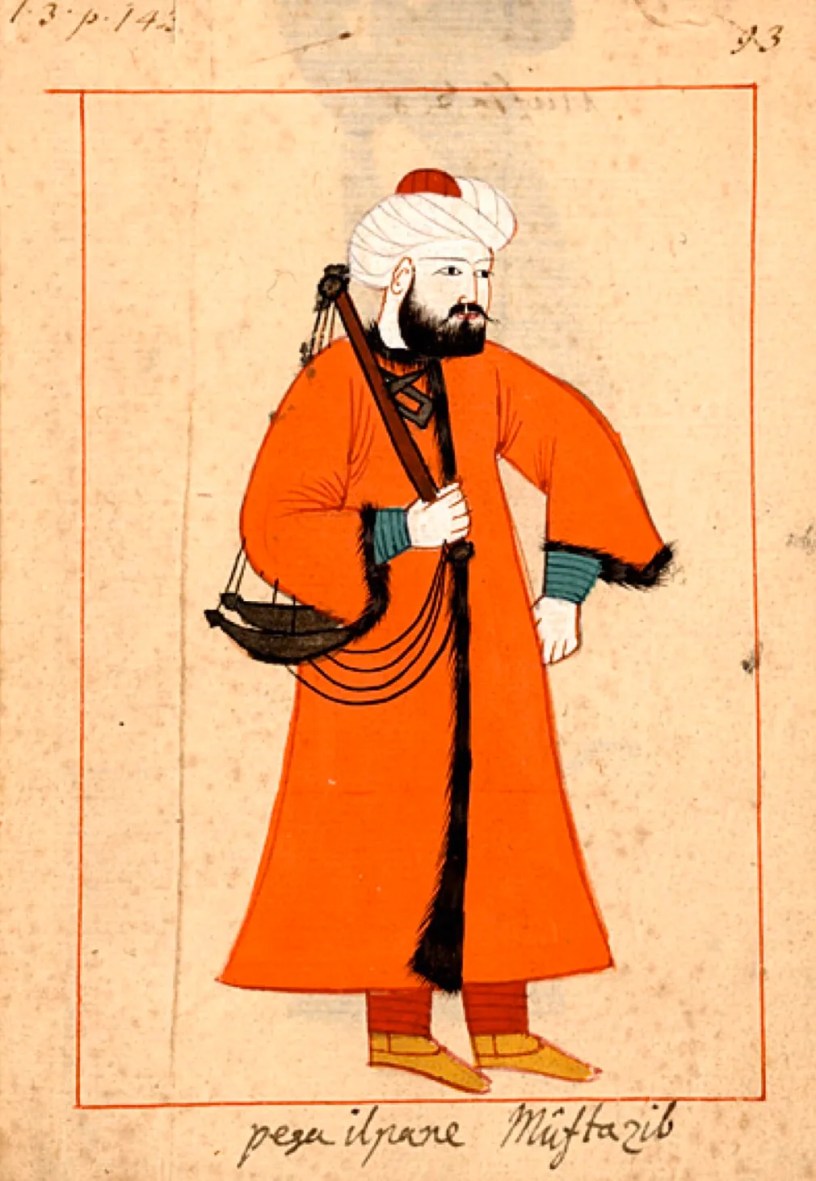
Do you know who the muḥtasib was?
For centuries, every Muslim knew. He wasn’t a scholar locked away in a study. He wasn’t a politician chasing votes. He was the man who walked through the markets — eyes sharp, scale in hand, conscience awakened — ensuring every transaction was just, every weight was fair, and every trader feared Allah in his business.
Today, that role is extinct.
Ask the average Muslim, and they’ve never even heard the word. Yet in the classical Islamic world, the muḥtasib was essential to public life — a guardian of moral order in the marketplace. Markets were not abandoned to greed and chaos. They were places of worship through commerce. Buyers and sellers were expected to know right from wrong, halal from haram. And when they forgot, the muḥtasib was there to remind them.
This was not considered a specialty. It was daily life.
As the saying goes:
“The trader is the first jurist.”
التاجر أول فقيه
Before scholars penned volumes on Islamic law, traders were already applying it. They had to know the rulings on contracts, interest, fraud, hoarding, and charity — not in theory, but in action. Commerce was a field of fiqh, ethics, and spirituality all at once.
This was a common understanding among Muslims for centuries. A man who entered the market without knowing the rulings of Allah was considered unfit to trade. The phrase التاجر أول فقيه wasn’t metaphor — it was reality. Traders couldn’t afford ignorance, because their trade was their worship, and their mistakes could be sinful.
The Collapse of the Ethical Market
Today, Muslims around the world buy and sell like everyone else — inside systems that have nothing to do with Islam. The average Muslim trader works under:
- Interest-based financing
- Manipulative advertising
- Unethical labor chains
- Unjust taxation
- Price gouging and speculation
- A complete absence of accountability
There is no muḥtasib.
There is no spiritual oversight.
There is no voice in the market saying: “Fear Allah.”
And worse: there is no concern.
A Forgotten Sunnah: The Prophet’s Marketplace
Few realize this, but one of the first actions of the Prophet (peace be upon him) in Madinah was the establishment of a free, ethical market — one that stood apart from the monopolized, exploitative markets already in place.
He declared:
“This is your market. Let no one take it over unjustly, and let no tax be levied upon it.”
(Ibn Shabba, Tārīkh al-Madīnah)
This was not just about buying and selling. It was about building a civilization:
- A market without exploitation
- Open access for all traders
- No manipulation or artificial inflation
- Supervised by ethical principles and God-consciousness
And the people who participated in it? They were trained to be moral individuals, accountable before Allah for how they earned and how they spent. The marketplace was a place of fiqh in motion — the Qur’an lived through contracts, weights, and honesty.
This is not a minor Sunnah.
This is a pillar of Islamic governance.
But What If I’m Just Selling Clothes?
A common response to this conversation is:
“I have a simple business. I’m not doing anything wrong.”
And that may be true on the surface. Many Muslim business owners — whether selling clothes, food, books, or services — are not actively committing fraud, charging interest, or oppressing anyone directly.
But this issue is not just about personal sin.
It’s about systemic neglect and structural injustice.
We must ask ourselves:
- Where are our goods coming from?
- Are the workers being treated fairly?
- Are we supporting unjust supply chains without knowing it?
- Do we price our goods in a way that considers the poor?
- Are our profits part of a larger economic structure that benefits the Ummah, or simply mirrors a global system that exploits the weak?
Most Muslim traders today don’t even ask these questions — not out of malice, but because the culture of ethical trade is gone. The market has become a purely material space, emptied of its spiritual and communal responsibility.
Even something as simple as a resale store or coffee shop — which may seem ethically neutral — is still embedded in a system that:
- Normalizes exploitation in global production
- Rewards profit over fairness
- Ignores zakat, charity, and community upliftment
- Disconnects us from our economic obligations to Allah
The Prophet (ﷺ) didn’t just avoid wrongdoing — he built a just economic model. A model that gave dignity to the poor, opportunity to the trader, and barakah to the market.
We are not sinful for surviving in a flawed system.
But we are accountable if we never even try to change it.
A Call to Rebuild
Reviving the Sunnah means more than growing a beard or praying in rows. It means rebuilding what the Prophet (ﷺ) established in society as his legacy:
- Ethical marketplaces
- Financial independence
- Economic justice
- Traders who are jurists
- Scholars who speak truth to wealth
The market is not outside Islam — it is a mirror of our collective soul.
And right now, that mirror reflects disunity, injustice, and abandonment.
It’s time we bring the muḥtasib back — not just as a person, but as a principle.
It’s time we reconnect trade with taqwa.
It’s time we revive the Sunnah of the just marketplace.
Not just for ourselves —
but for the dignity of the entire Ummah.
 One Ummah